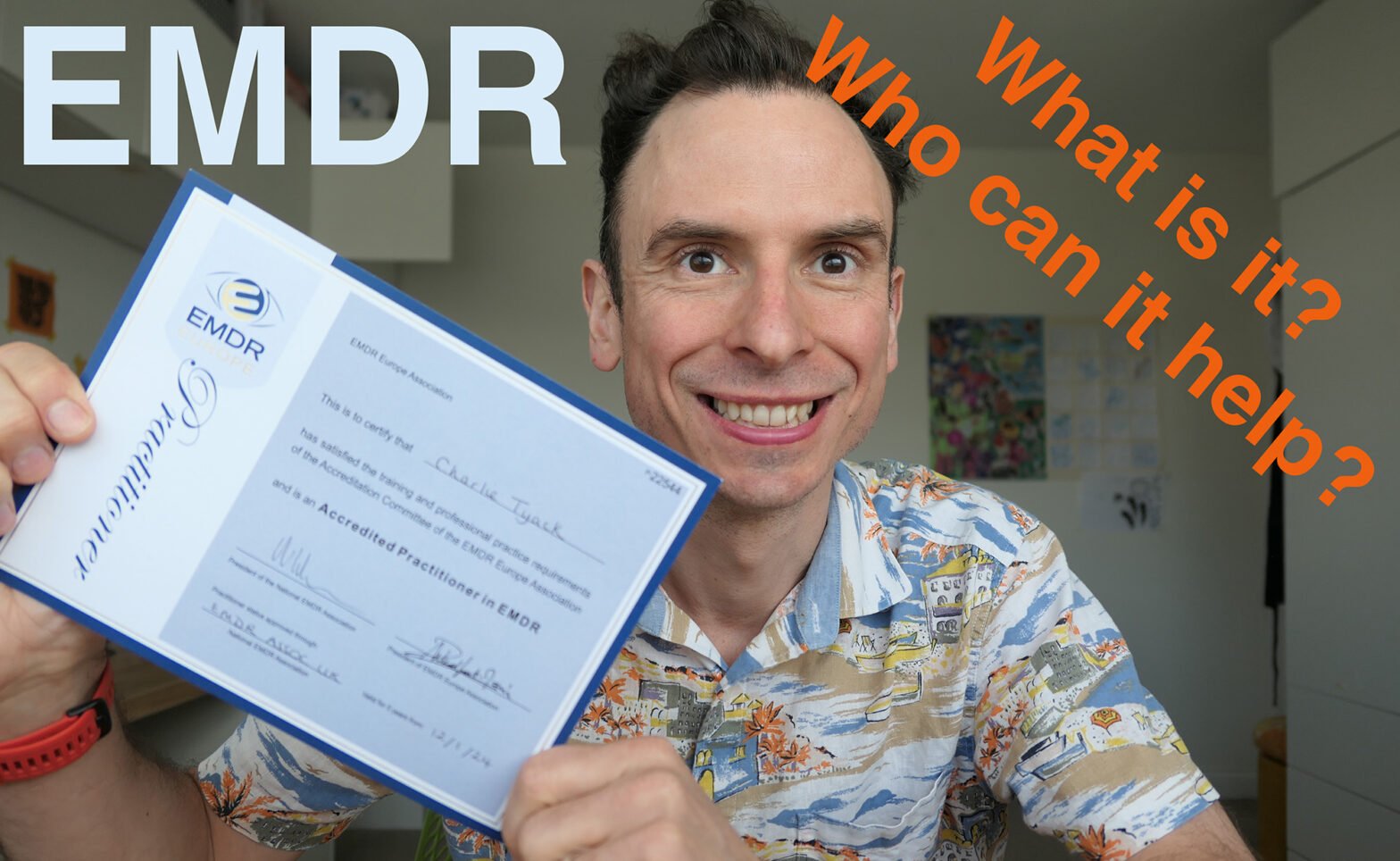
I receive repeated requests for a clear introduction to EMDR (eye-movement desensitisation and reprocessing) – what it is, who it can help, and what sessions look like. On that basis, I made the following video:
EMDR is a powerful type of therapy that was initially developed by Francine Shapiro for working with traumatic events, but which has since been found to be effective with a wide range of other mental health concerns. It can also be helpful beyond mental health, for example in coaching.
The “eye-movement” part of the name EMDR is also somewhat misleading, as we do not have to use eye-movements. We can use tapping, which can be performed either by the therapist or via self-tapping. We can use left-right sounds. We can also use more creative techniques like painting or even drumming. The main thing we are looking for is something that help us to keep one part of our attention on the event we are processing, and another in the here and now.
I hope the video is helpful. If you have any questions, do get in touch!
I am officially an EMDR Europe Accredited Practitioner. I am chuffed to be Accredited, having practised EMDR (Eye Movement Desensitisation and Reprocessing) since becoming an EMDR Practitioner in 2021. Accreditation means that I have met the following criteria:
Completed a recognised EMDR Europe training – with EMDR Academy in the UK
Completed a minimum of 50 EMDR sessions (over 250 at the time of writing)
Treated a minimum number of 25 clients (over 50 at the time of writing)
Undertaken over20 hours consultation/ clinical supervision with an EMDR Europe Consultant which includes witnessing my EMDR clinical work
Had my accreditation supported by an EMDR Europe Consultant and a colleague who vouched for my clinical practice.
The process of accreditation was really helpful and educational, and it serves as quality assurance for potential clients. It has been a privilege to work with so many people and witness the effectiveness that EMDR can have in a relatively short time frame.
EMDR is an evidence-based treatment that has been found to be effective with:
Post-Traumatic Stress Disorder (PTSD)
Complex PTSD
Anxiety
Panic attacks
Phobias
Performance anxiety
Nightmares
Chronic illness
Depression
Grief and loss
Pain
Addictions
Behavioural issues
Relationship issues
Please see the video at the top of this post for more information about EMDR.
If you have any questions about EMDR, please do get in touch or leave a comment.
As an “EMDR Practitioner”, qualified to work with adults and children, EMDR is one of the therapies I offer. Whilst it was originally developed for helping people to overcome traumatic experiences, it has since been found to be effective in treating a wide range of other concerns including:
Anxiety
Panic attacks
Phobias
Performance anxiety
Nightmares
Chronic illness
Depression
Grief and loss
Pain
Addictions
Behavioural issues
Relationshiop issues
The first stage of EMDR therapy involves assessment of the current problems, and what the client wants to work on. Sources of support and techniques to stay grounded and manage difficult symptoms are also explored and practiced. A plan is made collaboratively, taking into account pastexperiences, how their effects are manifesting in the present, and the client’s hopes for the future. Techniques the client can use to stay well in the here and now are also explored and strengthened before embarking on processing. Once the client feels ready, EMDR processing can begin.
The process involves the client bringing a target memory to mind, and the therapist supporting them to make side-to-side movements with their eyes, arms or via tracking sounds or tactile stimulation. It is thought that these side-to-side movements help the mind to shift into a mode where it is able to process unpleasant memories, taking away their power. This does not mean that the memories are gone, but the client’s relationship with them shifts to a more manageable, healthy one. Some people describe it as shifting from having a traumatic, vivid and visceral memory to simply “something that happened”. They might also find that their physical symptoms, such as pain or tension, improve.
EMDR Association explanation video
Prince Harry talks about his experiences of EMDR
EMDR can be helpful for adults and children. Adaptations can be made for people at different developmental levels and with different sensory needs.
EMDR association explanation video for children
You are welcome to contact me if you would like to explore EMDR therapy options.
The article Dr Naomi Boycott and I wrote about using Acceptance and Commitment Therapy for the treatment of non-epileptic seizures was recently published in the British Psychological Society’s Clinical Psychology Forum (Issue 347). It focuses on a service we developed for people who experience non-epileptic seizures, seeing people individually and in groups.
We felt that ACT was an especially appropriate model for helping people to manage their non-epileptic seizures for various reasons. These included the focus on living a life in a way that does justice to our values, the use of mindfulness processes to increase present-moment awareness and reducing experiential avoidance, as well as the emphasis on pain being a necessary part of living a full life. Russ Harris’s excellent Embracing Your Demons article gives a concise overview of ACT. We found that the model was generally well accepted. We also brought in strategies from more traditional CBT approaches and Compassion-Focussed Therapy as well as systemic and psychodynamic ways of formulating and working.
We found a range of resources that proved useful along the way. Here’s a selection of them:
“Extraordinary”, “weird” and “unprecedented” seem to be watchwords of the times we are living through. I keep hearing people describe the present, and situations that arise using these and similar expressions, perhaps to remind ourselves that it is okay not to know exactly how we should be responding. We encourage each other to “stay safe”, although I can’t help but notice a little spike of anxiety whenever I hear it. Battling a foe as nebulous as COVID-19 is anxiety provoking, as we naturally seek certainty, which is scarce at this stage.