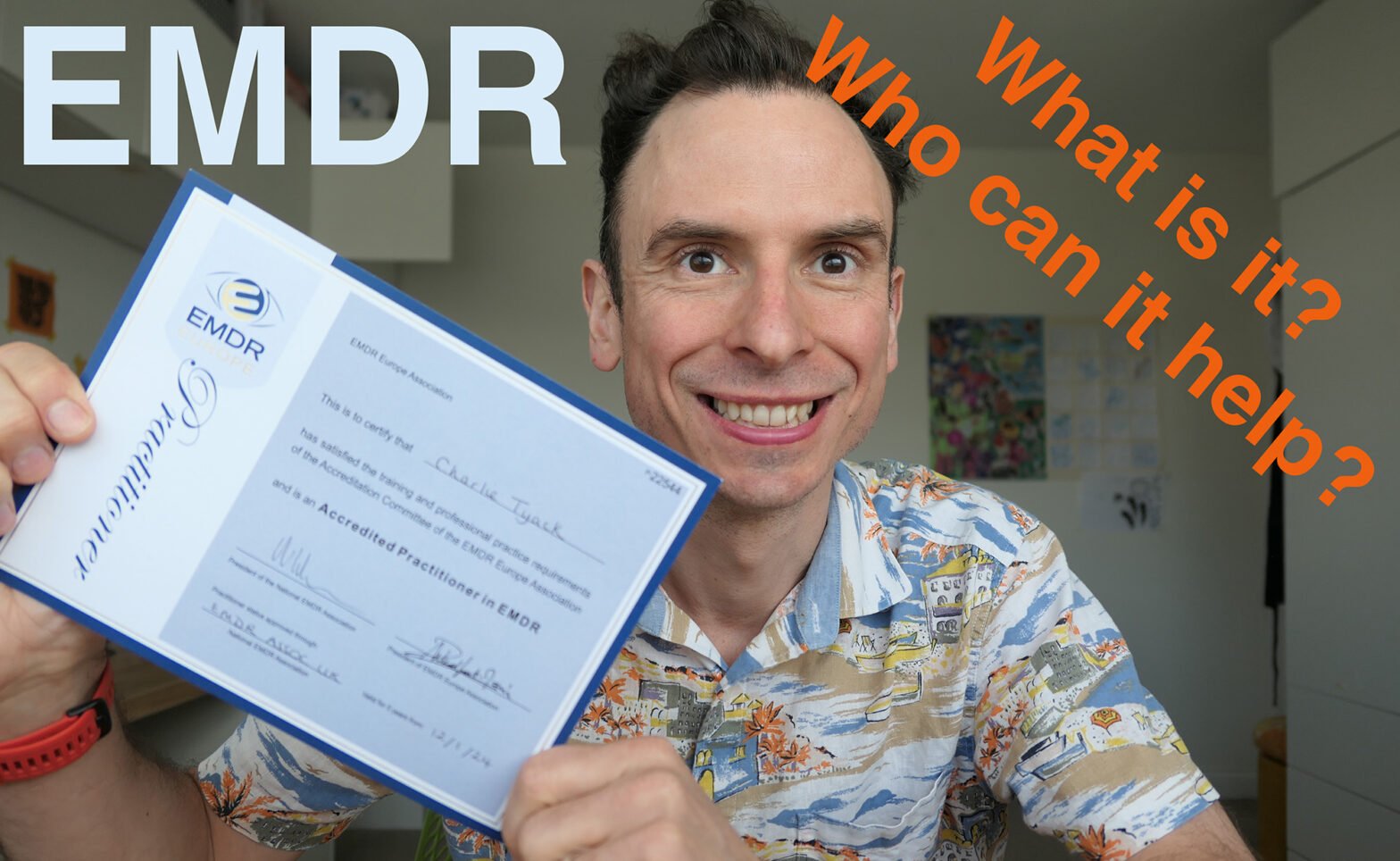
I receive repeated requests for a clear introduction to EMDR (eye-movement desensitisation and reprocessing) – what it is, who it can help, and what sessions look like. On that basis, I made the following video:
EMDR is a powerful type of therapy that was initially developed by Francine Shapiro for working with traumatic events, but which has since been found to be effective with a wide range of other mental health concerns. It can also be helpful beyond mental health, for example in coaching.
The “eye-movement” part of the name EMDR is also somewhat misleading, as we do not have to use eye-movements. We can use tapping, which can be performed either by the therapist or via self-tapping. We can use left-right sounds. We can also use more creative techniques like painting or even drumming. The main thing we are looking for is something that help us to keep one part of our attention on the event we are processing, and another in the here and now.
I hope the video is helpful. If you have any questions, do get in touch!
I have recently collaborated with my partner Mel to co-create a project that brings our passions together – Nurture.
Mel does the heavy lifting, and I produced a series of bite-size Chats With Charlie looking at various ways that techniques from therapy might help artists struggling with the creative process. They might also be useful for struggles in different areas. They are all about five minutes long and also showcase a range of hairstyles that betray the timeframe over which they were filmed!
The first gives an overview of Acceptance & Commitment Therapy (ACT):
The second looks at using Values to find the meaningfulness that helps to drive a creative process:
The second looks at various ways to overcome creative block:
This one uses strategies to help respond with compassion to our inner critic:
Overcoming decision paralysis:
Getting unstuck when we feel bogged down in the process:
This one looks at ways to stay true to our own creative voice whilst our attention is assailed from many angles by the distractions we have available to us!
Today, on UK FND Awareness Day 2025, I’m excited to share a new video that I hope will offer encouragement, information, and support to those living with Functional Neurological Disorder (FND). This day is all about raising awareness, breaking down stigma, and sharing resources — and I wanted to contribute something that feels both practical and hopeful.
Why I Made This Video
FND can feel confusing and overwhelming, especially when you’re first diagnosed. I know how important it is to have access to clear, information. This video is my way of helping to demystify psychological therapies and highlight useful resources to show how they can become valuable tools on your journey with FND.
What’s in the Video
In this video, I talk through different psychological therapies that have been shown to help people manage FND symptoms, including EMDR (Eye Movement Desensitisation and Reprocessing) and ACT (Acceptance and Commitment Therapy). These approaches can offer practical strategies and help build resilience.
But therapy isn’t the only resource out there. I also share helpful apps, websites, books, and even a comic that can provide everyday support and inspiration. Whether you’re newly diagnosed, supporting a loved one, or just want to understand more, I hope this video leaves you feeling empowered and hopeful.
Why It Matters
Awareness days like today are a reminder that no one has to face FND alone. With the right support and tools, it’s possible to navigate the challenges and build flexibility in the way we respond.
Join the Conversation
I’d love for you to watch the video and share your thoughts or experiences in the comments. The more we talk about FND, the more we can help each other feel seen, understood, and hopeful.
If you’ve ever struggled with sleep, you’ve probably been offered the usual advice: avoid screens before bed, keep your room dark, and stick to a bedtime routine. While these sleep hygiene tips sound great in theory, they don’t always work—especially for those dealing with insomnia.
Here’s the problem: Sleep hygiene is about creating a good sleep environment, but it doesn’t address the real issue behind chronic sleep struggles—your relationship with sleep itself. If you’ve tried everything and still find yourself tossing and turning, you’re not alone. In fact, rigidly following sleep hygiene rules can sometimes increase sleep anxiety, making it even harder to rest.
That’s where Cognitive Behavioral Therapy for Insomnia (CBT-I) comes in. Unlike sleep hygiene, CBT-I is a structured, evidence-based approach that targets the thoughts and behaviors keeping you awake. It helps you break free from the cycle of sleepless nights by resetting your sleep patterns, managing anxiety around sleep, and rebuilding confidence in your ability to rest.
I have been delivering CBT-I to people across the lifespan in adult and paediatric setting since training in it on Colin A. Espie‘s course at University of Glasgow sleep centre in 2011. I initially delivered it as part of a trial looking at CBT for insomnia in primary care that resulted in this article.
Each group was facilitated by two IAPT psychological wellbeing practitioners [i.e. me at the time], recent graduates, most but not all with psychology undergraduate degrees, who had undertaken a 1-year 1 day per week certificate course in low-intensity psychological interventions.
I have been lucky enough to have opportunites to work in sleep and build experience over the subsequent years, both before and since becoming a clinical psychologist. I have witnessed the huge beneficial impacts that optimising people’s sleep can have. I am currently working on a tailored CBT for insomnia package – watch this space for further updates.
In my latest video, I break down why sleep hygiene alone isn’t the solution—and how CBT-I can help you finally get the sleep you need. If you’re tired of struggling with insomnia, this might be the game-changer you’ve been looking for.
Watch now and take the first step toward better sleep!
Grief is a universal experience, yet it affects each of us in deeply personal ways. Whether from the loss of a loved one, the end of a relationship, or another life transition, grief can sometimes feel overwhelming and unending. While time can ease the pain, certain therapies can actively help us process grief in a healthier, more meaningful way.
Two powerful, evidence-based approaches—EMDR (Eye Movement Desensitization and Reprocessing) and ACT (Acceptance and Commitment Therapy)—offer unique ways to navigate grief, heal from loss, and rebuild a life that honors both your pain and your growth.
What is EMDR, and How Can It Help with Grief?
EMDR is best known as a trauma therapy, but it is increasingly used to help people process grief and loss. Developed by Dr. Francine Shapiro, EMDR helps individuals reprocess distressing memories by using bilateral stimulation (such as guided eye movements or tapping) to reduce the emotional intensity of painful thoughts and experiences.
How EMDR Supports Grief Healing
Reduces Emotional Overwhelm: EMDR helps process and reduce the intensity of sadness, guilt, or trauma-related symptoms that can accompany grief.
Reframes Painful Memories: Instead of feeling trapped in the past, EMDR allows you to process memories in a way that feels meaningful.
Encourages Adaptive Healing: EMDR doesn’t erase grief—it helps integrate the loss into your life in a way that allows for emotional balance.
Many people who experience complicated grief (prolonged or traumatic grief) can find that EMDR helps them release some of the emotional blockages keeping them stuck.
What is ACT, and How Can It Help with Grief?
Acceptance and Commitment Therapy (ACT) encourages people to accept their emotions rather than suppress or avoid them. Instead of fighting against grief, ACT helps you develop psychological flexibility—allowing you to feel your emotions fully while still taking steps toward a meaningful life.
How ACT Supports Grief Healing
Encourages Emotional Acceptance: ACT teaches that pain is a natural part of life, and fighting grief often makes it worse. Instead, ACT promotes making space for your emotions.
Aligns Actions with Values: ACT helps people identify and make moves towards what truly matters—whether that’s relationships, creativity, or self-care.
Uses Mindfulness to Reduce Suffering: Through mindfulness techniques, ACT helps individuals stay present rather than getting stuck in rumination about the past or fear of the future.
By embracing grief rather than avoiding it, ACT empowers people to integrate loss into their lives in a way that fosters growth and meaning.
Which Therapy is Right for You?
EMDR and ACT offer valuable tools for grief healing, but they serve different purposes:
If you feel stuck in painful memories or trauma-related grief, EMDR may help reprocess those emotions in a way that brings relief.
If you struggle with avoidance, emotional suppression, or difficulty moving forward, ACT can help you accept your grief while building a fulfilling life.
The approaches are complementary: a combination of both can often be the most effective strategy.
Final Thoughts: You Don’t Have to Grieve Alone
Grief is not something to “get over,” but it is something you can learn to live with in a way that allows for healing and peace. Whether through EMDR, ACT, or another therapeutic approach, support is available.
If you or someone you love is struggling with grief, consider reaching out to me or another mental health professional trained in these therapies. Healing is possible, and you deserve the space to process your loss in a way that honors your experience.
💙 Have you tried EMDR or ACT for grief? Share your thoughts in the comments.
In today’s fast-paced world, stress and anxiety can feel like uninvited companions. When life throws challenges your way, it can be easy to feel overwhelmed or untethered. That’s where the “dropping anchor” technique comes in – a powerful yet simple mindfulness and grounding exercise designed to help you regain stability and come back into the here-and-now.
What Is Dropping Anchor?
The dropping anchor technique is rooted in Acceptance and Commitment Therapy (ACT), a therapeutic approach that emphasizes mindfulness and values-driven action. It was made popular by Dr Russ Harris, who brought together various existing mindfulness and grounding exercises. The metaphor of “dropping anchor” reflects the idea of staying grounded even when emotional storms are raging. Just as an anchor helps a boat remain steady amidst waves, this technique helps you stay centered during stressful or overwhelming situations.
The process involves three key steps: Acknowledge, Come back, and Expand (A-C-E). They shift our attention from inside our minds, into our bodies and finally into our surroundings. Let’s explore each step in detail.
Step 1: Acknowledge
The first step is to acknowledge your thoughts, feelings, and sensations. Instead of fighting or avoiding them, take a moment to notice what’s happening inside you. For example, you might say to yourself:
“I notice that I’m feeling anxious.”
“I’m aware of the tension in my body and the racing thoughts in my mind.”
The goal here is to observe your internal experience without judgment. Simply name and acknowledge what you’re feeling. This also allows you to take a step back from your internal experience, see it more objectively, and gives you the option to respond in a novel way, rather than simply reacting on autopilot without thinking.
Step 2: Come back
Once you’ve acknowledged your internal experience, the next step is to ground yourself in the present moment. This involves coming back into your physical body to connect with the here and now. Here are some grounding actions you can try:
Plant your feet on the ground. Notice the sensation of your feet pressing against the floor.
Stretch. Lengthen your back, and gently draw circles with your nose, first in one direction and then in the other.
Take slow, deep breaths. Focus on the rhythm of your inhalation and exhalation. Notice the expansion as you breathe in and the relaxation as you breathe out. Notice the cooling as you inhale, and the warmth as you exhale.
Grounding places you in your physical environment, which can serve as an anchor during life’s storms.
Step 3: Expand
The final step is to expand your awareness to the world around you. Shift your attention to your surroundings and notice the details. This might include:
5 things you can see
4 things you can touch
3 things you can hear
2 things you can smell
1 thing you can taste
By engaging with your environment, you can regain focus, even amidst emotional turmoil.
Why Does It Work?
The dropping anchor technique works because it’s grounded in mindfulness and acceptance. By acknowledging your emotions instead of trying to push them away or control them, you reduce their power over you.
When to Use the Dropping Anchor Technique
This technique is versatile and can be used in a variety of situations, including:
During moments of acute stress or anxiety.
When you feel overwhelmed by negative thoughts or emotions.
Before tackling a challenging task or decision.
With practice, dropping anchor can become something that you automatically use when necessary. You can run through all of the steps in under a minute, or take longer on each step and really savour the process. As with all grounding and relaxation techniques, it is important to practice it initially at times when you are not stressed, so that your brain does not learn to associate the technique with being stressed and anxious!
Final Thoughts
The dropping anchor technique is a reminder that, even in the midst of chaos, you have tools to stay grounded. By acknowledging your emotions, grounding yourself in the present, and engaging with your surroundings, you can weather life’s storms with greater resilience and clarity and have more choice about how you respond.
Practice this technique so that you can give it a try the next time you’re feeling overwhelmed, and see how it can help you stay steady in the face of life’s challenges. Remember, you don’t have to try to control the storm – you just need to anchor yourself through it.
I am officially an EMDR Europe Accredited Practitioner. I am chuffed to be Accredited, having practised EMDR (Eye Movement Desensitisation and Reprocessing) since becoming an EMDR Practitioner in 2021. Accreditation means that I have met the following criteria:
Completed a recognised EMDR Europe training – with EMDR Academy in the UK
Completed a minimum of 50 EMDR sessions (over 250 at the time of writing)
Treated a minimum number of 25 clients (over 50 at the time of writing)
Undertaken over20 hours consultation/ clinical supervision with an EMDR Europe Consultant which includes witnessing my EMDR clinical work
Had my accreditation supported by an EMDR Europe Consultant and a colleague who vouched for my clinical practice.
The process of accreditation was really helpful and educational, and it serves as quality assurance for potential clients. It has been a privilege to work with so many people and witness the effectiveness that EMDR can have in a relatively short time frame.
EMDR is an evidence-based treatment that has been found to be effective with:
Post-Traumatic Stress Disorder (PTSD)
Complex PTSD
Anxiety
Panic attacks
Phobias
Performance anxiety
Nightmares
Chronic illness
Depression
Grief and loss
Pain
Addictions
Behavioural issues
Relationship issues
Please see the video at the top of this post for more information about EMDR.
If you have any questions about EMDR, please do get in touch or leave a comment.
I just received a copy of Helping Your Autistic Child by Ann Ozsivadjian. It includes chapters by various authors who specialise in working with children with neurodivergent conditions, including my chapter on sleep.
My chapter includes sections on:
Why autism can increase the chance of sleep difficulties
As an “EMDR Practitioner”, qualified to work with adults and children, EMDR is one of the therapies I offer. Whilst it was originally developed for helping people to overcome traumatic experiences, it has since been found to be effective in treating a wide range of other concerns including:
Anxiety
Panic attacks
Phobias
Performance anxiety
Nightmares
Chronic illness
Depression
Grief and loss
Pain
Addictions
Behavioural issues
Relationshiop issues
The first stage of EMDR therapy involves assessment of the current problems, and what the client wants to work on. Sources of support and techniques to stay grounded and manage difficult symptoms are also explored and practiced. A plan is made collaboratively, taking into account pastexperiences, how their effects are manifesting in the present, and the client’s hopes for the future. Techniques the client can use to stay well in the here and now are also explored and strengthened before embarking on processing. Once the client feels ready, EMDR processing can begin.
The process involves the client bringing a target memory to mind, and the therapist supporting them to make side-to-side movements with their eyes, arms or via tracking sounds or tactile stimulation. It is thought that these side-to-side movements help the mind to shift into a mode where it is able to process unpleasant memories, taking away their power. This does not mean that the memories are gone, but the client’s relationship with them shifts to a more manageable, healthy one. Some people describe it as shifting from having a traumatic, vivid and visceral memory to simply “something that happened”. They might also find that their physical symptoms, such as pain or tension, improve.
EMDR Association explanation video
Prince Harry talks about his experiences of EMDR
EMDR can be helpful for adults and children. Adaptations can be made for people at different developmental levels and with different sensory needs.
EMDR association explanation video for children
You are welcome to contact me if you would like to explore EMDR therapy options.
As a psychologist with a special interest in sleep, interesting projects sometimes come my way. One of these recently came to fruition in the form of a chapter in the newly published Oxford Handbook of Sleep Medicine, edited by Guy Leschziner. I am very grateful to Guy for the invitation to contribute.
My chapter covers presentations of insomnia across the childhood age range, and ways to treat them. At present the synopsis is incorrect and the correct one is as follows:
Various behavioural approaches have been shown to ameliorate sleep in children who have difficulties with initiating sleep and getting back to sleep during the night. The fundamentals of these techniques are the same irrespective of the underlying health or environmental concerns. Essential foundations of good sleep include consistent sleep timings with a nightly pre-bed wind-down routine, which is maintained at weekends and during school/nursery holidays, and age-appropriate bedtimes. This chapter focusses mainly on behavioural interventions to address unhelpful sleep associations that younger children might develop, leading them to “need” parental presence in order to initiate sleep, and following night wakings. Behavioural interventions depend on caregiver engagement; habit change is effortful for all involved. Central to assessment should be clarifying goals of the child (if possible) and their caregivers. Patients (and their families) and clinicians can hold differing beliefs about ideal sleep, owing to societal, cultural and familial influences. Beliefs about medications can also play a role: some people would prefer the change be effected via medication than take a more active role in behavioural change. Motivational interviewing can support this process, and SMART (specific, measurable, attainable, reasonable and time-based) goals should be established.
You can access the book for free from an NHS-connected computer:
I have good news – no need to wait and no need to Kindle – already available to all at GSTT https://t.co/MKxG3ZsPs7 login free from GSTT network machines and NHS OpenAthens everywhere else. I think available to all NHS staff in England but need to check
I also did a Q & A session with The Sleep Charity later in the week, as part of their sleep practitioner training. There were some excellent questions from the delegates, including one about sleep disruption in children who are on the autistic spectrum. Since questions in relation to this come up a lot, here’s a link to my ACAMH session on Autism and Sleep in Children.
I really enjoyed offering a Q&A session to the delegates of @TheSleepCharity Sleep Practitioner Training this week. Lots of excellent questions, including a familiar one about sleep in children with #autism. These vids might help – https://t.co/uQPU35OkUN